






Paraboot
Paraboot: Alpine heritage at your feet – why these shoes say more than they show
When a shoe manages to look both archaic and urban at the same time, it often has a little green flag on the side ;) Paraboot is the kind of brand that doesn't shout. It speaks softly, with a "thick" sole, Norwegian stitching, and the austere elegance of a company that originated in the workshop culture of the French Alps. The story began in Izeaux in 1908; today, the factory is located in Saint-Jean-de-Moirans, at the foot of the Chartreuse Mountains. It is still family-run, still with the same stubborn commitment to material authenticity that makes the brand so distinctive. The name "Paraboot" itself is an old world travel name: in 1927, the founder registered the brand name – "Para" after an Amazon port from which rubber was exported, "boot" an American word he had picked up while traveling. A name like a map.
What sets Paraboot apart from other traditional shoemakers is its rare vertical manufacturing process: the French company manufactures its own sturdy rubber soles – vulcanized from natural rubber, developed for durability and all-weather suitability. This is the exception in the shoe world; others buy soles from specialists. Paraboot's control over the material is not just a romantic manufacturing detail; it explains the characteristic cushioning, weight, and grip – and makes the models faithful companions in a "post-sneaker" everyday life.
Paraboot's formal vocabulary is straightforward: derbies, loafers, boots. The tone: weatherproof, French pragmatic. The Norwegian seam (cousu norvégien) is a defining feature of the craftsmanship, with its double thread – visible from the outside – connecting the upper, frame, and sole. The result: stability, repairability, and natural water resistance that you immediately appreciate on rainy days. Depending on the model, it is complemented by Blake or Goodyear variants.
Paraboot Michael: The Tyrolean derby that outlasts fashions
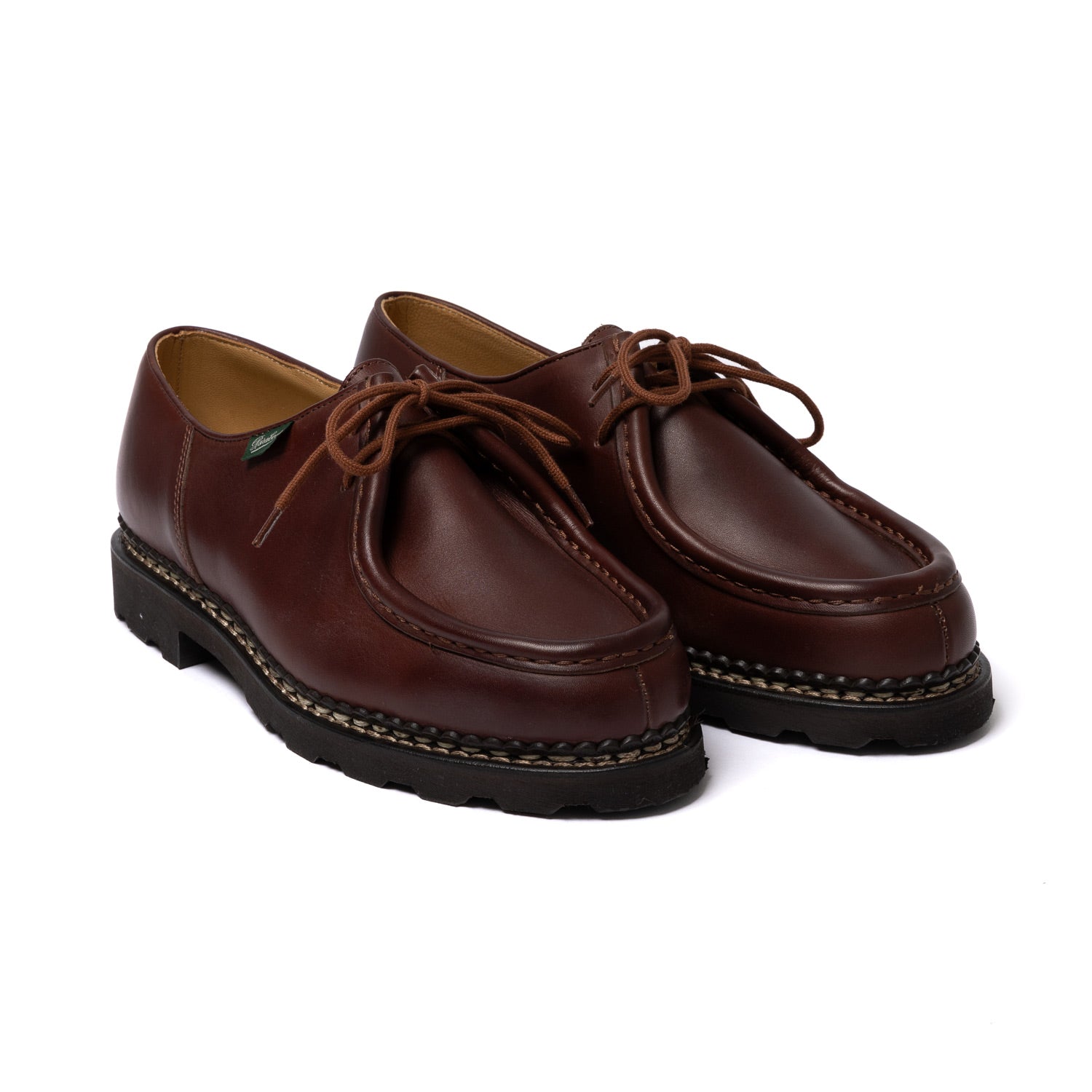
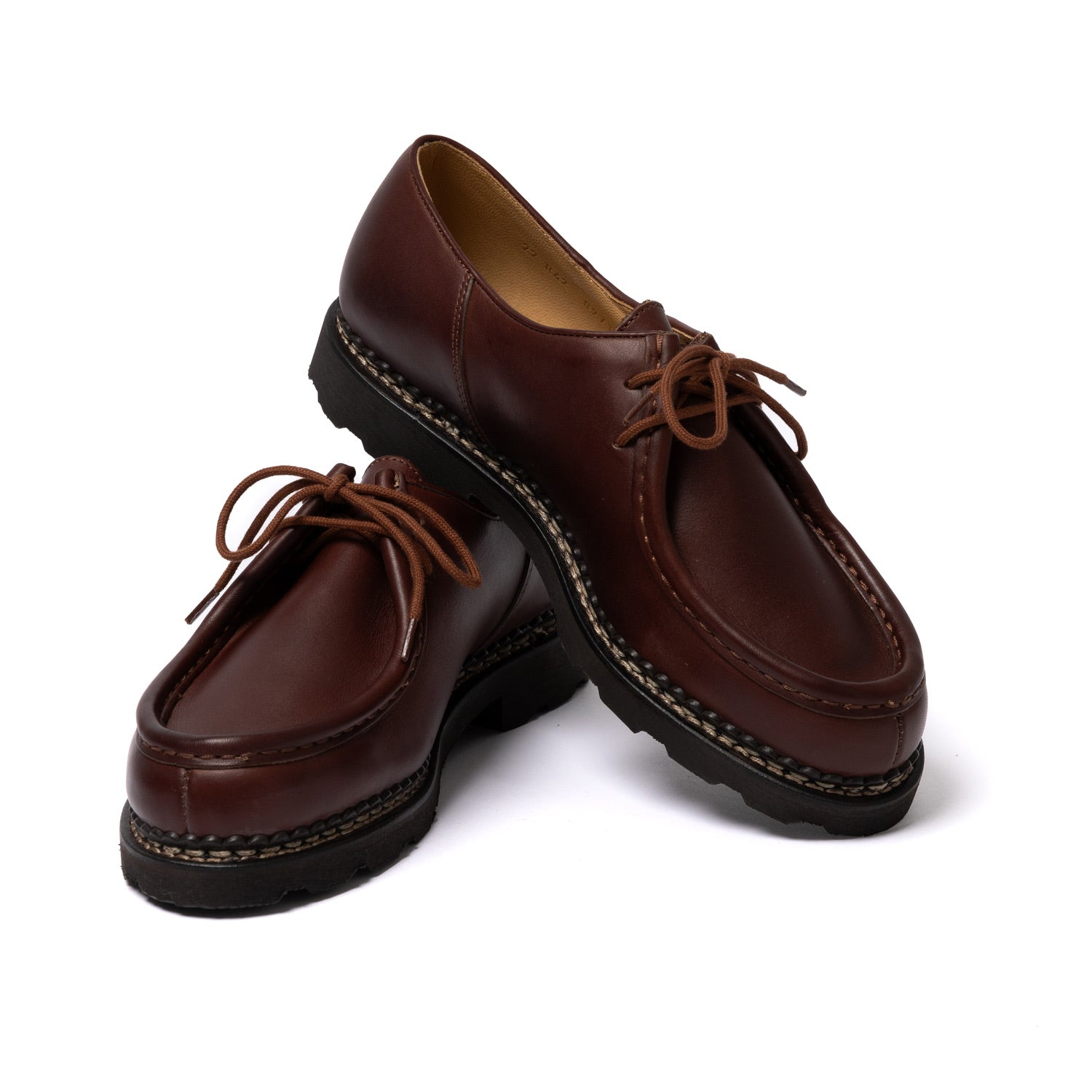
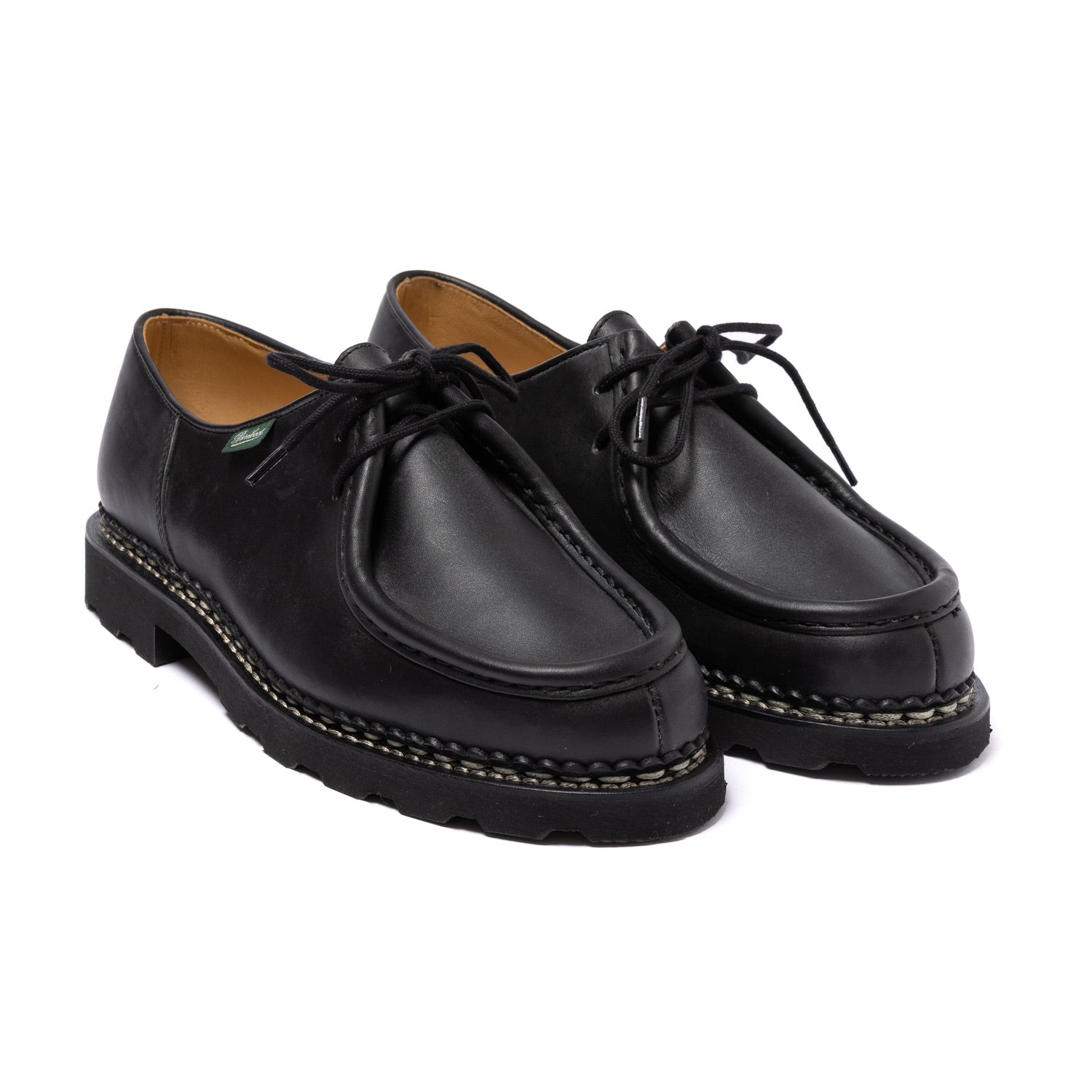
Although the name suggests otherwise, the Paraboot Michael is not a special model for Michael Jondral, but rather an evergreen from Paraboot. In 1945, at a time of scarce resources, the second generation of the family designed a two-hole Derby with thick leather, a distinctive piped frame, strong stitching, and a rubber sole from their own production. So where does the name come from? A little family legend: "Michel" – the current president of the company – became the Anglo-Saxon-sounding "Michael." And so a post-war compromise became an icon.
The cultural resonance of this shoe is astonishingly consistent – and currently "louder" than ever. In 2025, the Michael will celebrate its 80th birthday: to mark the occasion, Paraboot has released eight limited editions, each one a journey through time to a decade since 1945 – from the graphic black and white of the sixties to the textile tech looks of more recent years. The project, led by designer Basile Lapray, does not feel like nostalgia, but rather proof that substance does not have to age. Production continues in Saint-Jean-de-Moirans.
Even beyond anniversaries, the Michael is one of those rare shoes that is both an insider's signal and an everyday solution. GQ recently described it as one of the hottest products of the season – an 80-year-old Tyrolean derby that appears in the Lyst Index alongside Miu Miu and Saint Laurent. Why? Because it resolves a paradox: as robust as a work boot, as sophisticated as a city derby. The moc-toe seam and the voluminous yet comfortable rubber sole bring a graphic presence that sneaker fans understand – while the authenticity of the craftsmanship appeals to classic wearers.
Technically, it is legitimized by the Norwegian seam, which makes the shoe not only durable but also permanently repairable. Paraboot explicitly documents the Michael as resolable – an invitation to consider the shoe as a long-term investment. The fact that the brand has been offering its own repair service and selected partners for decades makes this promise credible. A Michael is not built for "fashion cycles," but for distance. And distance is the opposite of fashion.
Stylistically, the Michael thrives on nuances. In smooth leather, it looks like an elegant field jacket for the ankle; in Poils de Vache (calf hair), it tells a French suede joke; in muted brown tones, it accompanies Rota flannel pants as naturally as Resolute's raw denim! The volume calls for clever proportions on top: heavy cardigans and coats or tweed jackets.
Paraboot loafers: Reims, Barth & Co. – the casual alphabet of French craftsmanship
Loafers often evoke the Ivy League look, campus paths, and penny slots. Paraboot tells the same story – only with alpine traction. The spectrum ranges from the sturdy Reims to the more elegant Barth; in between are small but noticeable differences in lasts, frames, and soles that have a massive impact on the overall effect.
The Reims is Paraboot's penny loafer with character – a moccasin with piping, "beefroll" tassels on the seams, and a clear statement: this is not a delicate slipper, this is city suitability with mountain genes. Handcrafted in France, mostly with Norwegian stitching, the Reims sits on a vulcanized rubber sole that takes wet cobblestones just as seriously as office floors. It is the loafer for people who don't want to miss out on the comfort of a sneaker, but want to replace it with craftsmanship.
The Paraboot DNA is particularly evident in the materials: from smooth calfskin to hair-on leather variants that give the silhouette an almost graphic texture. Anyone who wears the Reims/Marche version in "Poils de Vache" immediately understands why Paraboot is not a generic "heritage" term, but a haptic promise. Even in classic black, the Reims remains visually present without being loud, thanks to its piping and frame. A loafer that takes jeans with white Oxfords just as seriously as flannel with a turtleneck.
In terms of construction, Paraboot remains true to its credo. The sole is also the focus of the loafers – because the company manufactures it itself. This gives them that Paraboot-typical combination of grip and cushioning that makes them wearable all day long. The Norwegian seam (where used) is not an end in itself, but a function: double-stitched, visible on the outside, with the aim of warding off moisture and everyday wear and tear and facilitating later resoling. For the wearer, this means a loafer that not only "goes with" but also "grows with" them.
Paraboot sale: buy smart, wear long – a guide to deals without compromise
You don't buy Paraboot to "take something with you" – you buy it to arrive. In a house like Michael Jondral's, that means not hunting for the lowest price, but calmly choosing the right pair at the right time. The much-cited term "Paraboot sale" may be floating around the internet in an inflationary manner, but here it takes on a new meaning – as an invitation to recognize curated opportunities when they quietly arise: a rare leather color, the last size of a classic, an edition that rounds off the range rather than disrupting it. It's less about "discounts" and more about relevance.
The attitude behind this is consistent: Paraboot stands for substance – vulcanized rubber soles from its own production, robust designs, models that last for decades. Those who think this way are not interested in the short-lived "now or never," but in fit: How does the pair fit into my wardrobe? Will it carry me through wet November days as well as a week in the city? Can it be resoled in two or three years and still remain my shoe? The "right moment" is then not necessarily a seasonal brand, but a lifestyle brand. Curated occasions – be it a subtle color variation, a special upper, a limited material mix – act as door openers: you don't just find "an offer," you find your Paraboot.